How people decide when and how to use GenAI
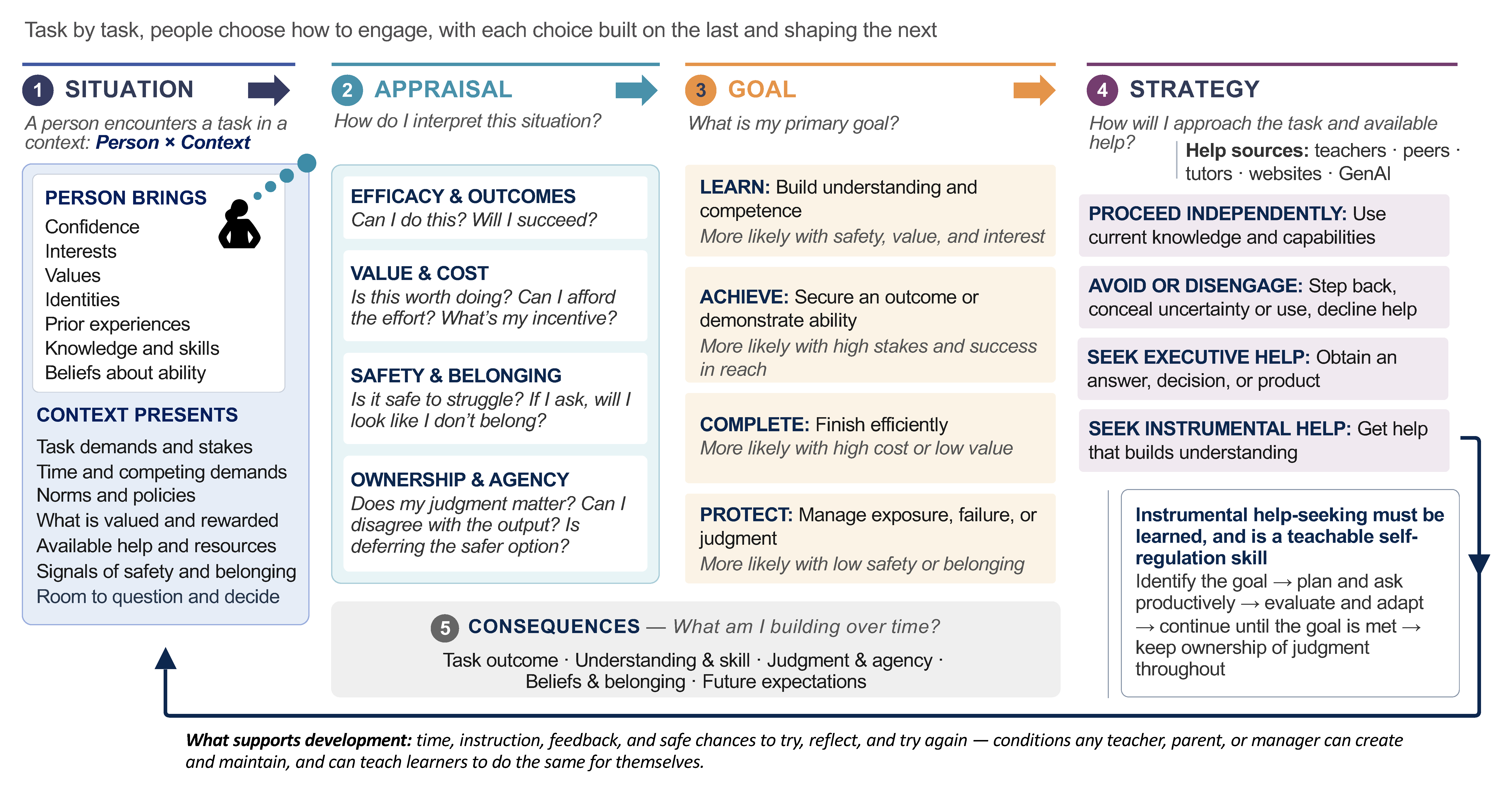
Task by task, people choose how to engage. Each choice is built on the last and shapes the next.
For more information, see Trzesniewski, Gripshover, & Master (2026).
What we mean by an effective user of generative AI
An effective user of GenAI has the capacity to:
- know how, when, and when not to use GenAI, evaluated against where the technology is currently reliable and where it fails;
- match GenAI use or nonuse to the goal for the current task and situation;
- use GenAI to enhance thinking, learning, and work.
Read the model as text
1. The situation. A person meets a task in a context. The person brings confidence, interests, values, identities, prior experiences, knowledge and skills, and beliefs about their ability. The context presents the task's demands and stakes, time and competing demands, norms and policies, what is valued and rewarded, the help and resources available, signals of safety and belonging, and room to question and decide.
2. The appraisal. The person reads the situation through four questions. Efficacy and outcomes: can I do this, and will I succeed? Value and cost: is this worth doing, can I afford the effort, and what is my incentive? Safety and belonging: is it safe to struggle, and if I ask, will I look like I don't belong? Ownership and agency: does my judgment matter, can I disagree with the output, and is deferring the safer option?
3. The goal. Those appraisals shape a primary goal. To learn, building understanding and competence, which is more likely with safety, value, and interest. To achieve, securing an outcome or demonstrating ability, more likely with high stakes and success in reach. To complete, finishing efficiently, more likely with high cost or low value. To protect, managing exposure, failure, or judgment, more likely with low safety or belonging.
4. The strategy. The goal shapes how the person approaches the task and the help around them, whether teachers, peers, tutors, websites, or GenAI. They may proceed independently, using their current knowledge and capabilities. They may avoid or disengage: step back, conceal uncertainty or use, or decline help. They may seek executive help, obtaining an answer, a decision, or a product. Or they may seek instrumental help, getting help that builds understanding. Instrumental help-seeking must be learned, and it is a teachable self-regulation skill: identify the goal, plan and ask productively, evaluate and adapt, continue until the goal is met, and keep ownership of judgment throughout.
5. The consequences. Each choice leaves something behind: the task outcome, understanding and skill, judgment and agency, beliefs and belonging, and future expectations. These carry into the next situation, so each choice is built on the last and shapes the next. What supports development is time, instruction, feedback, and safe chances to try, reflect, and try again: conditions any teacher, parent, or manager can create and maintain, and can teach learners to create for themselves.